
 Image 1 of 3
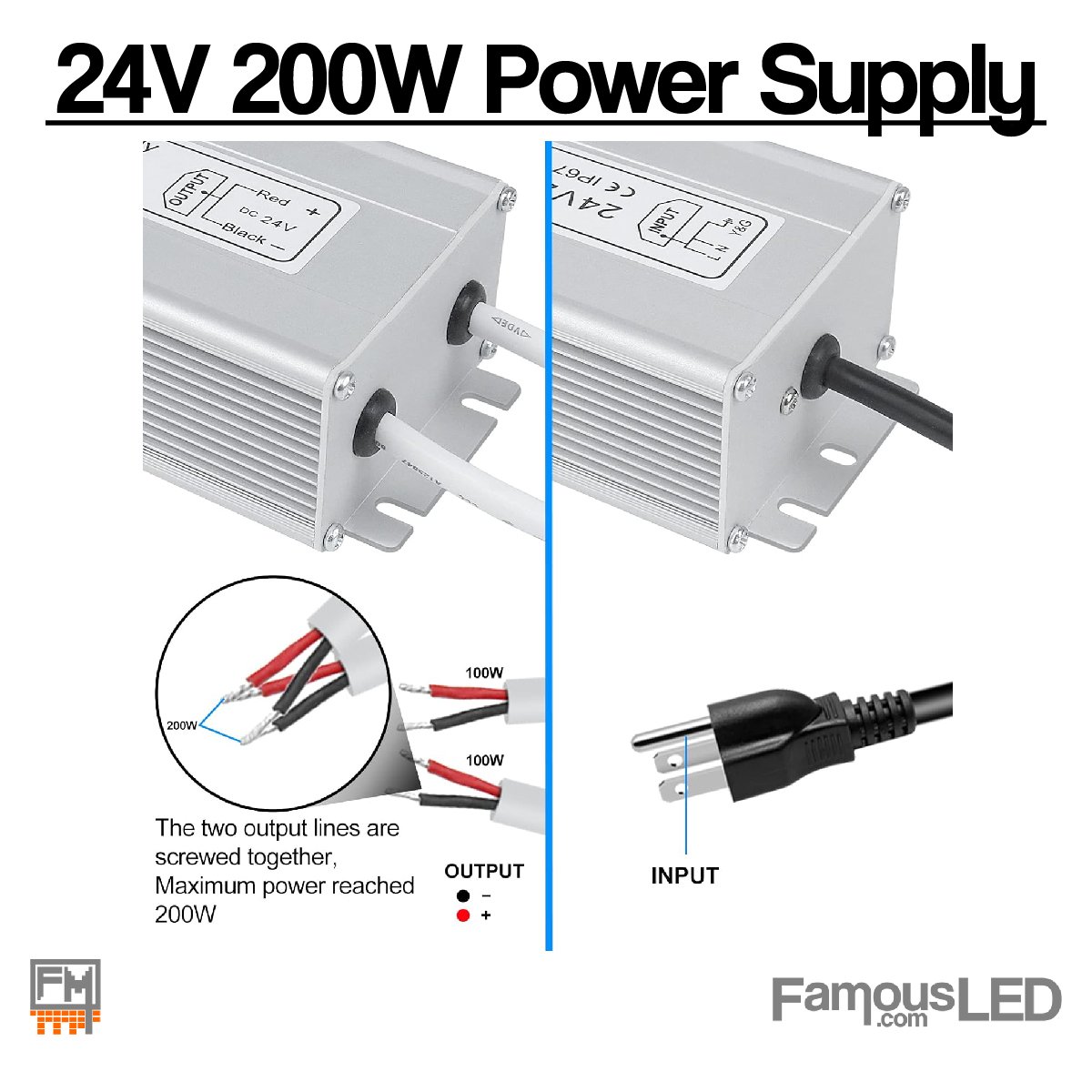 Image 2 of 3
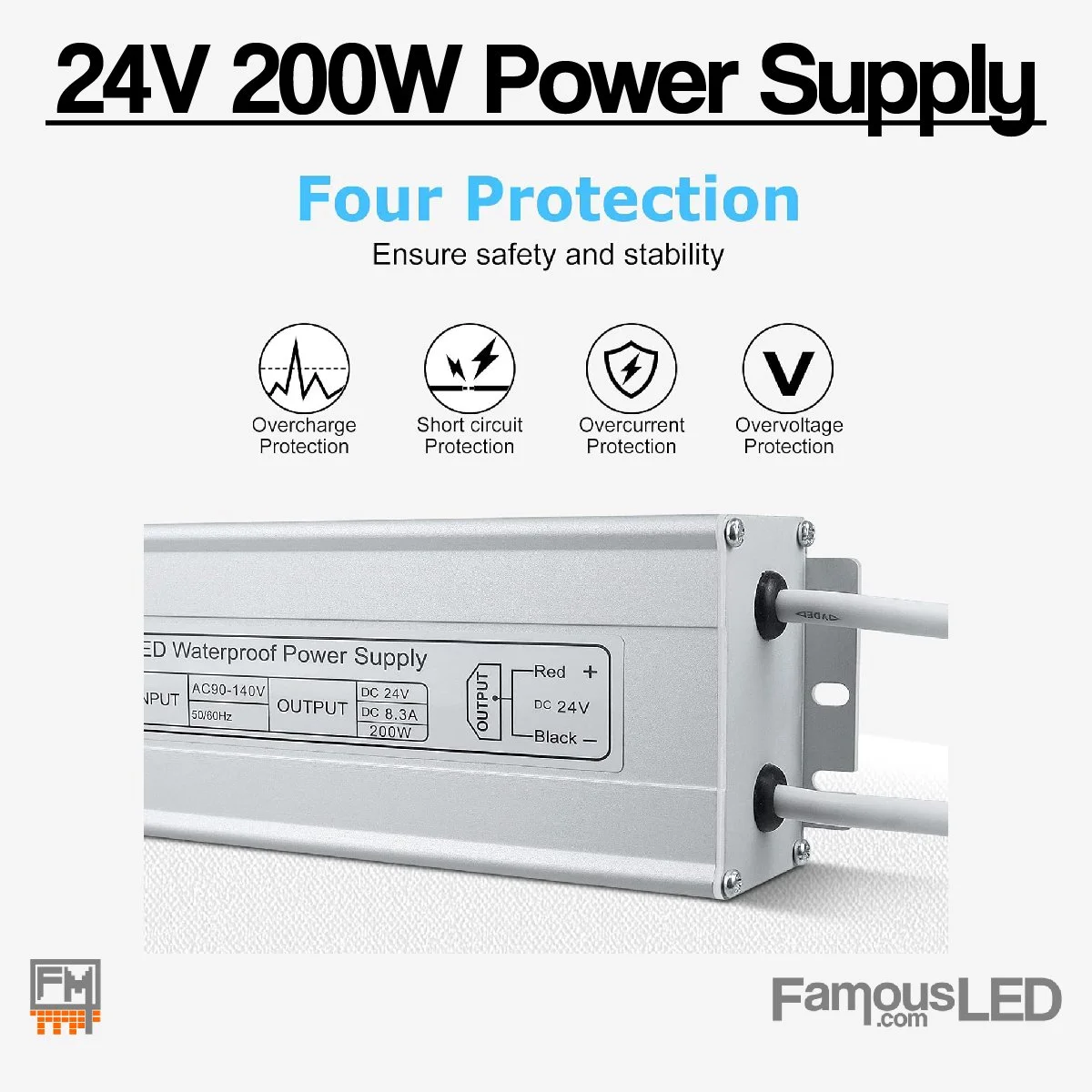 Image 3 of 3
Description
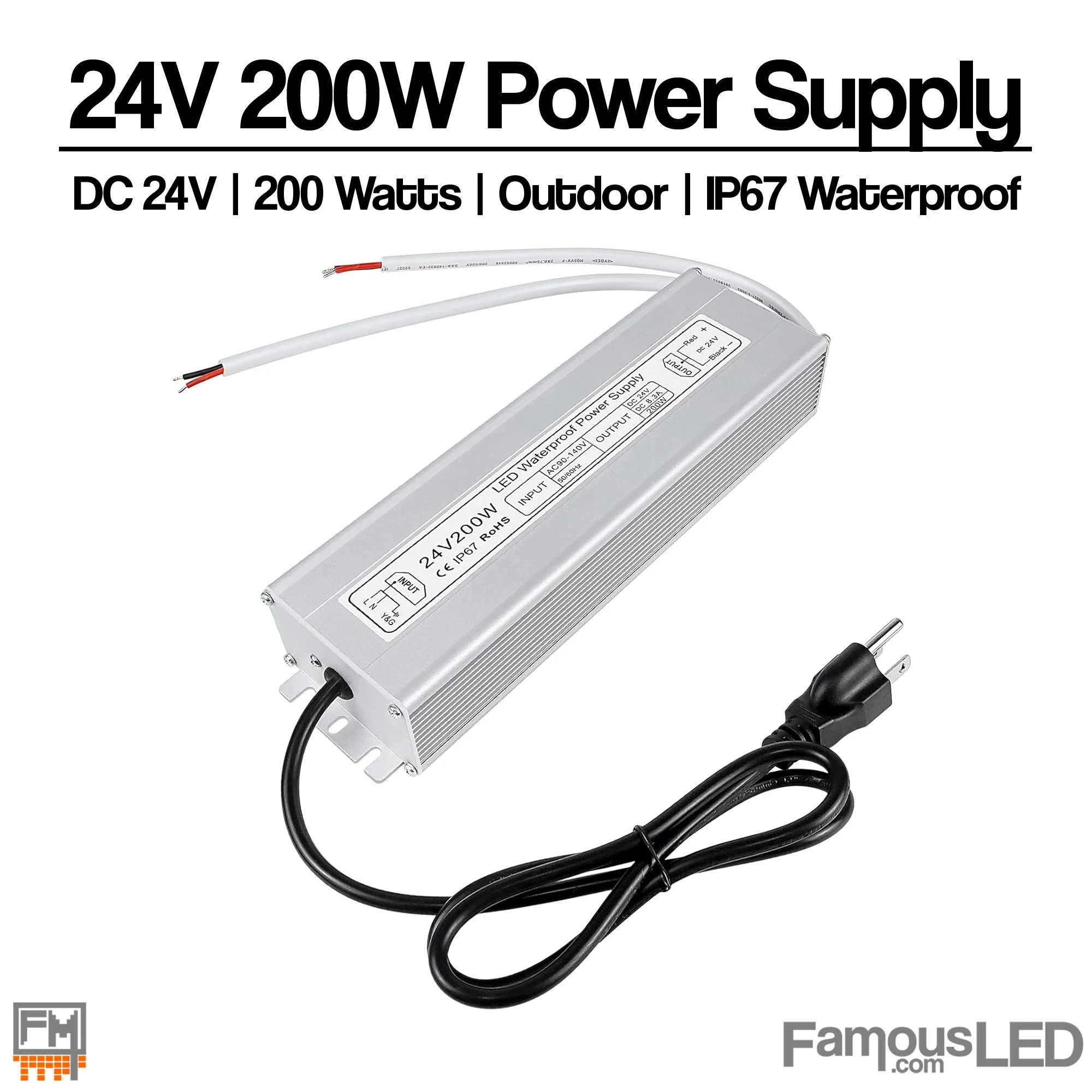
The FamousLED 24V 200W IP67 Outdoor LED Power Supply is designed to convert AC input power into stable 24V DC output for compatible low-voltage LED lighting products.
This power supply is commonly used with 24V LED strip lights, LED modules, signage, landscape lighting, accent lighting, and other 24V DC applications that require a durable outdoor-rated power source.
The aluminum alloy housing helps with heat dissipation and long-term durability, while the IP67-rated enclosure provides protection for outdoor, damp, and moisture-prone installations.
For best performance and longer service life, we recommend using no more than 80% of the rated output capacity for continuous operation. For this 200W power supply, that means a recommended continuous load of approximately 160W or less.
Please make sure your LED product requires 24V DC before connecting. This power supply does not dim LEDs by itself and should only be used with compatible 24V DC lighting, controllers, and accessories.
Features
- Converts AC input power to 24V DC output
- Rated for up to 200W maximum output
- Recommended continuous load: 160W or less
- IP67-rated design for outdoor and damp-location use
- Aluminum alloy housing helps dissipate heat
- Suitable for 24V LED strip lights, LED modules, signage, landscape lighting, and accent lighting
- Built-in protection for safer operation
- Supports short-circuit, overload, over-voltage, over-current, and over-temperature protection
- Hiccup mode protection with auto-recovery after the fault condition is removed
- Designed for compatible 24V DC LED lighting products
Technical Specifications
- Product Type: 24V AC-to-DC LED Power Supply
- Input Voltage: 90–140V AC
- Input Frequency: 50/60Hz
- Output Voltage: 24V DC
- Output Current: 8.3A Max.
- Rated Output Power: 200W Max.
- Recommended Continuous Load: 160W or less
- Efficiency Guideline: Use at or below 80% load for best long-term performance
- Housing Material: Aluminum Alloy
- Outdoor Rating: IP67
- Protection Features: Short Circuit, Overload, Over-Voltage, Over-Current, Over-Temperature
- Recovery Type: Hiccup Mode / Auto-Recovery
- Application: 24V LED Strip Lights, LED Modules, Signage, Landscape Lighting, Accent Lighting, and Compatible 24V DC Products
Frequently Asked Questions
-
This power supply converts AC input power into 24V DC output. It is commonly used for 24V LED strip lights, LED modules, signage, landscape lighting, accent lighting, and other compatible 24V DC products.
-
No. This power supply outputs 24V DC and should only be used with products designed for 24V DC input. Using it with 12V LEDs can damage the LEDs.
-
The maximum rated output is 200W, but we recommend keeping the continuous load at or below 80% for best long-term performance. That means about 160W or less for continuous use.
-
This power supply is IP67-rated, making it suitable for outdoor and moisture-prone installations. It should not be treated as permanently submersible unless the manufacturer specifically confirms that use.
-
Yes, the IP67-rated housing is designed for outdoor and damp-location use. Make sure all wire connections, extensions, and controllers used with it are also properly rated and protected for the installation environment.
-
No. This power supply provides constant 24V DC output. Dimming or color control requires a compatible LED controller installed between the power supply and the LED product.
-
Yes, as long as the addressable LEDs require 24V DC and the controller is compatible with the LEDs. The power supply only provides power; it does not create data signals or lighting effects.
-
For longer LED runs or high-wattage installations, power injection may be needed to reduce voltage drop. Always calculate the total wattage and check the voltage at the far end of the LED run.
-
The DC output wires can usually be trimmed or extended as needed, but all connections should be made safely, with correct polarity, proper wire gauge, and weatherproof protection when used outdoors.
-
Confirm that your LED product is 24V DC, calculate the total wattage, stay within the recommended load, verify polarity, and make sure all wiring and connectors are rated for the installation environment.